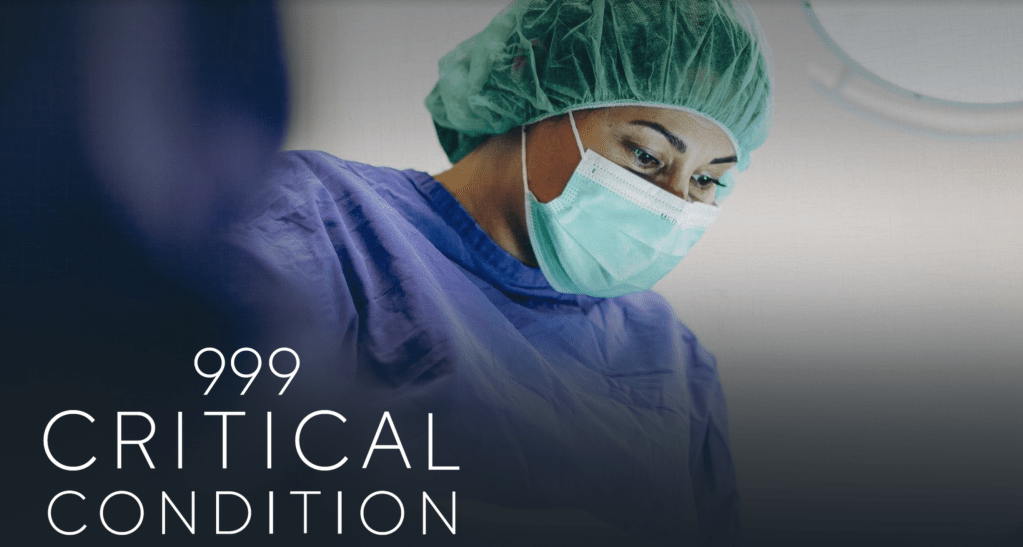
Review of docu-series centred on a UK major trauma emergency unit.
Channel 5 produced five seasons of a documentary located at the Royal Stoke Univesity Hospital in Staffordshire, UK. The series can be viewed on the My5 catch-up service; episodes can now also be streamed via a Netflix subscription.
My5 link: https://www.channel5.com/show/999-critical-condition
As mentioned in the hospital’s own website, the film crew spent six months at the Major Trauma Centre, shadowing hospital staff as they dealt with patients arriving at the accident and emergency unit with critical medical conditions.

The documentary approach of the series reminds me of another series reviewed on Meddie.org – Surgeons: At the Edge of Life (see post) but 999: Critical Condition uses a different style. Whereas Surgeons focused on a few cases per episode and visualised the complexity of the surgical operations in great detail, 999 spends less time on the operation and more on the thought process and steps that lead to diagnosis.
This means that we follow the lead clinician’s thought process from the time the patient is brought into Major Trauma, when preliminary investigations and reports from the paramedics are used to narrow down the next phase of treatment, on to the body scans and then on to surgery, if applicable.
A number of realities of working in this area of the NHS quickly become apparent.
The first is the importance of team work. The lead clinician oversees a multi-disciplinary team of health professionals. Information is gathered by multiple staff members in an ordered manner and decisions need to be made quickly due to the critical nature of the patient’s condition.
I think it would be impossible to achieve positive outcomes in such an environment without mutual respect between the healthcare professionals and a clear hierarchy/structure for duties.
Secondly, the doctors in charge of each case have great power and at the same great responsibility, as they absorb each new item of information and use this to order the next set of tests and/or hand over the patient to different departments. Patients place themselves in the care of doctors and expect the latter to treat them to the best of their ability. This sense of trust is a foundation of patient-doctor care.
As a viewer, it is natural to wonder how staff members in emergency units deal with the stress of having to follow the correct course of treatment for each patient under enormous stress. Every minute counts and focus on the patient must be constant. The pace is fast and each decision can make a huge difference to a patient’s life.
Similarly stressful must be the scenarios where the hospital cannot help, for example when a patient’s condition is too severe and there is not enough time to save them. The second episode of the first series also showed a patient who could not be operated on because of their medical history.
The hospital consultant thus had to inform the patient that their body could not sustain a major operation due to historical heart problems and that they were about to die. This aspect of their work must be very difficult for hospital staff, even those with experience. A great deal of empathy must be shown towards the patient and their family as they prepare for the inevitable death.
In conclusion, I think this series is insightful and will be of great help to aspiring medics who already envisage working in an accident and emergency department.



Leave a Reply