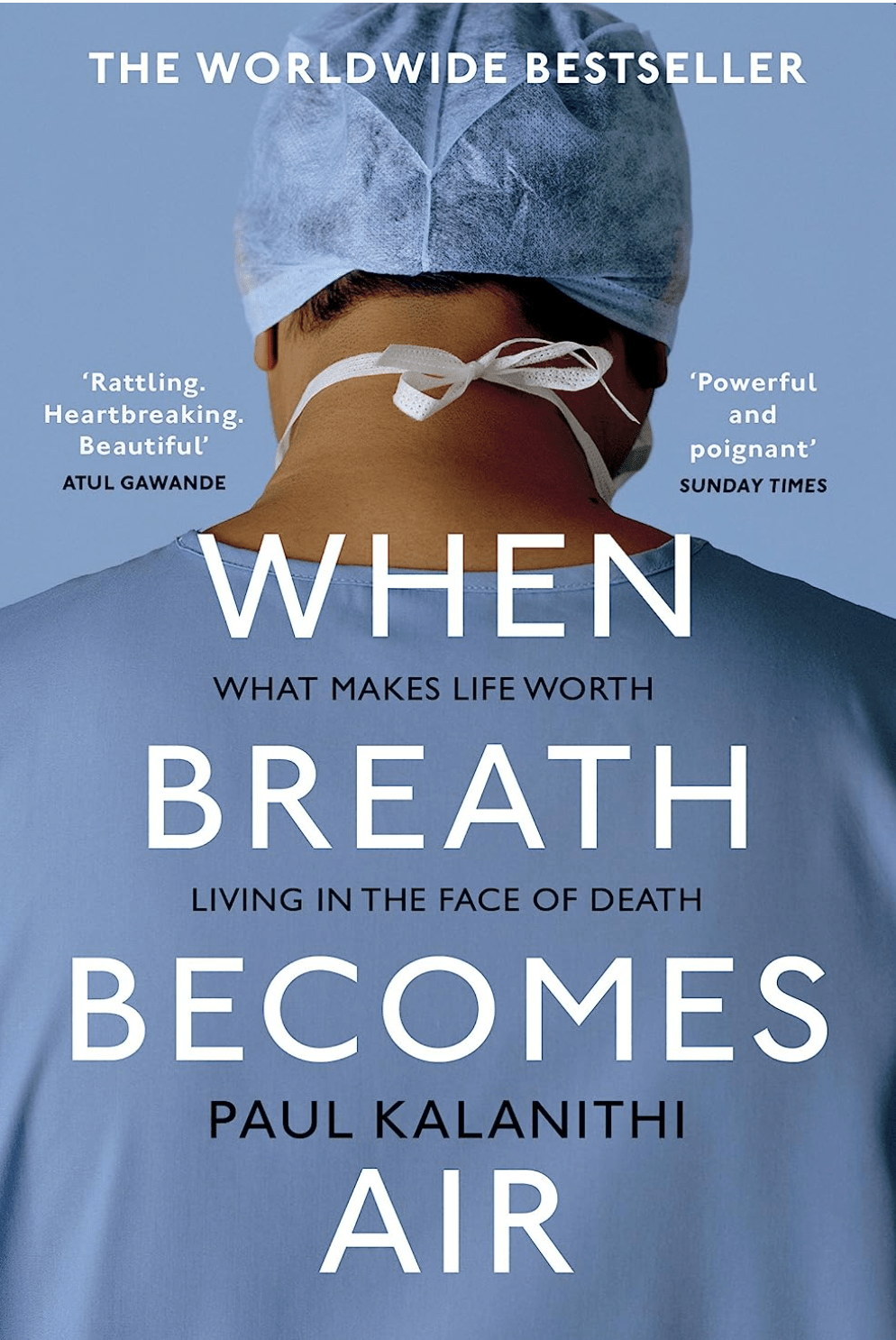
My personal review of the remarkable memoir by Dr. Paul Kalanithi, which discusses his life and questions around mortality.

Book details:
| Publisher | Vintage (2017) |
| Language | English |
| Pages (paperback) | 256 |
| ISBN-10 | 9781784701994 |
| ISBN-13 | 978-1784701994 |
Review – Part 1:
“When Breath Becomes Air” is a non-fiction book detailing the life and the events leading up to the death of Dr. Kalanithi, a Stanford neurosurgeon, in March 2015. Note: the book’s premise (life and terminal illness of the author) is clearly stated in the blurb so this is not a spoiler for prospective readers.
Paul Kalanithi was born in New York in 1977, but moved to rural Arizona at a young age. There he attended Kingman High School, where the graduation rate was significantly lower than the average American high school. He developed as a student and graduated as a valedictorian (in the US, the highest ranking student in a graduating high school class), and proceeded to study BA English Literature and BSc Human Biology at Stanford.
His ambition and passion was to become an author. However, one day he realised he desired to understand the wider meaning of life, and therefore enrolled in the medicine course at Yale (a prestigious US university) after completing his first degree. Note: in the US, students typically enrol in medical school as graduates.
He specialised in neurosurgery, and he detailed the ups and downs of his experience. For example, during his training time with the Obstetrics and Gynaecology team, Dr Kalanithi described how he felt about successfully delivering babies after a particularly strenuous birth:
“I was a prophet returning from the mountaintop with news of a joyous new covenant!”
However, this feeling of triumph was quickly eroded when another doctor later updated him about another case he was helping with, in which a baby died. This highlights the quick-changing life of a doctor, and additionally how difficult it can be to cope when upsetting news are regularly presented. As a doctor, one must carry on with that on the back of one’s mind.
Although not explicitly acknowledging his guilt about the baby’s death, Dr. Kalanithi addressed what he called the “flip side of joy”, as all doctors must be prepared for “the unbearable, unjust, unexpected presence of death”. He mentions the lack of comfort he felt in these distressing situations. This honest account by Dr. Kalanithi showing the highs and lows of practising medicine made me feel gratitude, as a reader and a human being, for the services doctors and healthcare colleagues provide daily.
Review – Part 2
In the second part of the book, Dr. Kalanithi describes how he began experiencing conspicuous symptoms of cancer; eventually in 2013 he was diagnosed with metastatic (advanced) stage 4 lung cancer.
See Cancer Research UK‘s web page about this type of cancer: https://www.cancerresearchuk.org/about-cancer/lung-cancer/stages-types-grades/stage-4
He documented the realities of being a cancer patient over the next 2 years. Although he felt as if it were a humbling experience, he was determined to make an impact on lives. He temporarily went back to neurosurgery in between his diagnoses.
However, his condition rapidly deteriorated, as he lost a lot of weight and suffered from severe back pain. He describes several activities that helped him maintain a healthy mental wellbeing – the birth of his daughter Elizabeth Acadia (Cady) being one of the best days of his life.
His positive outlook on life showed how despite the lack of time left, being a patient didn’t feel like the end of the world. He also noted the extensive support network of colleagues, such as Emma, who treated him with honesty and respect, always incorporating the feelings of his family. This underscored the importance of the caring nature that every doctor must possess.
One theme that Dr. Kalanithi emphasised was the importance of time: how you should never waste time thinking about the future as there are many possibilities – for example, death, becoming a writer or being completely healthy.
Unfortunately, Dr. Kalanithi passed away in March 2015, surrounded by the love of his family. In the book’s epilogue written by his wife, Dr. Lucy Kalanithi, she stated that “Paul [in his last days] was full of hope for days that were full of purpose and meaning”. This is inspiring, as despite the heartbreaking ending, Paul Kalanithi showed how you should life with ambition – you will never know how much time you have left alive, and that time is never meaningless.
I would highly recommend this book as it has made me aware how the life of a doctor has many ups and downs. Moreover, the book is special in that it shows the perspective of a doctor being treated as a patient, giving me insight into their feelings.



 Meddie
Leave a comment