
A number of UK media outlets today published statistics on the incidence of melanoma cancer cases in the UK.
What is melanoma?
The NHS website describes melanoma as a type of skin cancer that can spread to other areas of the body. The consensus is that the main cause of melanoma is exposure to ultraviolet light, either directly from the sun or via sunbed tanning.
Statistically, age and skin complexion can greatly increase the chance of developing melanoma, with older, lighter-skinned people more likely to contract the cancer. Other factors include family history of skin cancer and having a large number of moles.
The best form of prevention is by being careful in the sun by limiting exposure and also by applying sunscreen on bare skin.
The main treatment for melanoma is surgery to remove the melanoma and other areas of the body where the cancer has spread.
Another comprehensive source of information on melanoma and the non-melanoma skin cancer variant is the Cancer Research UK charity website.
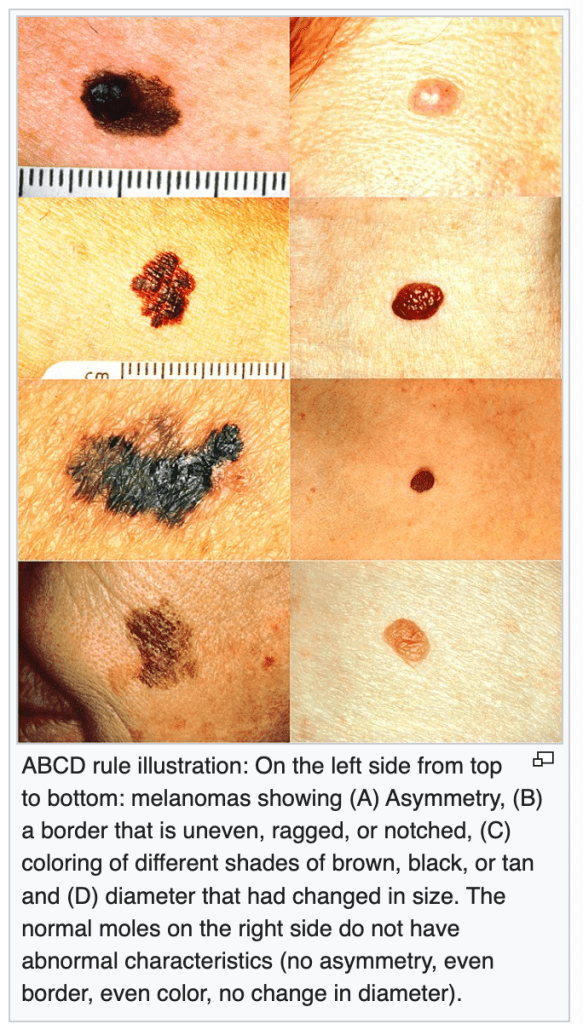
Wikipedia has an entry for melanoma, which includes the following diagnostic diagram:
Why is melanoma in the news?
The incidence of melanoma skin cancer cases in the UK has reached an all-time, with a steady increase over the past decade. New diagnoses have increased over a period of 10 years (up to and including 2019 figures) to 28 cases every 100,000 people. This is according to Cancer Research UK analysis:

[click the image to access content]
The interesting observation is that melanoma cancer rates vary by age – the rate increase for people over 80 years is 57% (!) and for younger people (25-49 years old) it was 7%.
The age distribution and other factors influencing melanoma rates is described in much greater depth in The Lancet journal:

[click image to access journal]
The main reason for this variance may be a much greater awareness by younger people about the dangers of exposure to ultraviolet (UV) light.
Also, the UK has a growing and ageing population. Some of these older citizens would have spent long hours in the sun whilst on holidays when cheap package holidays in warmer countries first became available in the 1970s, and knowledge of the dangers of UV radiation was not widely appreciated.
In a reverse trend, the number of deaths due to melanoma are falling. Early diagnosis of melanoma greatly increases survival rates, with circa 90% of adults expected to survive the cancer for 10 years or more.
For my generation, the message is clear: whenever we go outside of our home during daytime, we must take great care to either avoid direct UV radiation and/or apply sufficient sunscreen to protect our skin.
References
Cancer Research UK – https://news.cancerresearchuk.org/2024/05/27/skin-cancer-cases-reach-all-time-high/
The Lancet – https://www.thelancet.com/journals/lanepe/article/PIIS2666-7762(21)00001-6/fulltext
Wikipedia – https://en.wikipedia.org/wiki/Melanoma
BBC – https://www.bbc.co.uk/news/articles/c2ll0eywz37o
The Guardian – https://www.theguardian.com/society/article/2024/may/27/rates-melanoma-skin-cancer-research-uk-figures-study


 Meddie
Leave a comment