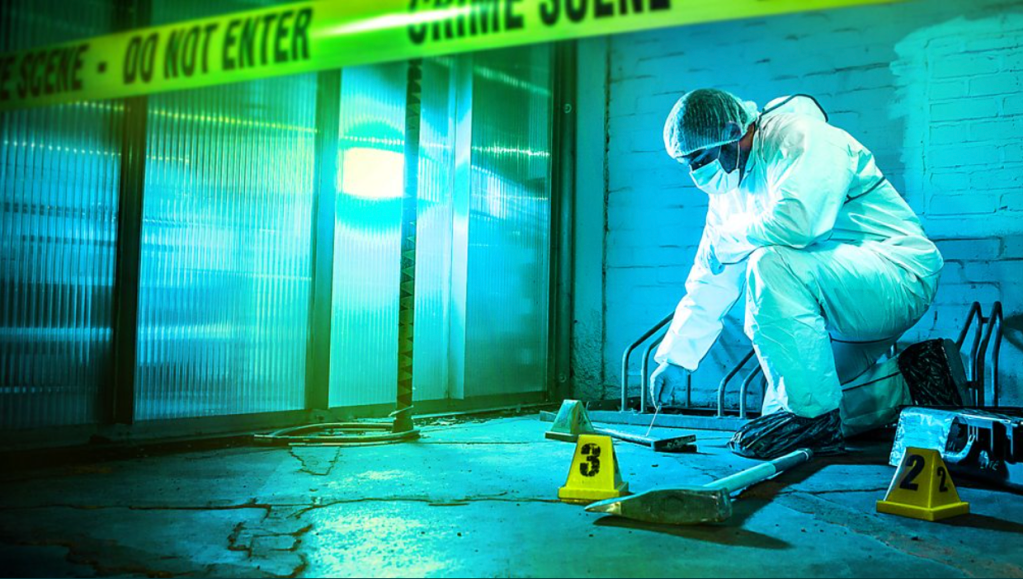
For this article, I reviewed a TV series that explores the application of forensic medicine/science to criminal cases and the crucial contribution of forensics in determining the cause and circumstances of major crimes.
There is some ambiguity as to whether forensics is indeed a branch of medicine or a separate science – I found diverging opinions in different forums – but there definitely is enough overlap for forensics to be associated with, as a minimum, pathology. I therefore recommend exploring this subject for all aspiring medics.
The TV series presented by the BBC is a collaboration with the Open University. The programme websites I accessed are:
- https://www.bbc.co.uk/programmes/m0004p7f
- https://connect.open.ac.uk/society-psychology-and-criminology/forensics-the-real-csi
There are four series available on the BBC iPlayer (see first link above) and each episode highlights the role of forensic analysis in assisting police officers. The crimes committed vary greatly: robberies, sexual attacks, murders and so on.
We recover evidence and evidence tells the story.
Each episode describes the investigation from discovery of the crime to the eventual court case. This approach preserves the chronological order of the discoveries made by the police and forensic teams. This non-fiction, documentary-style presentation is therefore less polished than custom-written fictional dramas (like the US series “CSI”), which can sometimes present facts and sub-stories in specific order so as to increase viewer entertainment.
I am conscious that any description of the episodes will invariably contain spoilers so I will limit my comments to two episodes, which I think provide a good example of what Forensics: The Real CSI is about.
Body in the Freezer
This episode begins with a body found in a discarded freezer in Birmingham, UK; the body had decomposed and it was not possible to readily determine the length of time the body had spent at that location.
The body is a very important piece of evidence. In this case, it had belonged to an adult Caucasian male of a certain age (grey-white hair). Decompositional change, driven by bacteria, had altered the body considerably; moreover, the skin surface showed discolouration, being green and very dark in places.
Fingerprints are one of the last body parts to degrade and a partial set was extracted and checked against a national database, without a match.
Police work eventually led to a flat where the freezer was believed to have originated. Neighbours had in the past complained of a ‘smell’ emanating from the flat but a police visit had not found anyone at home.
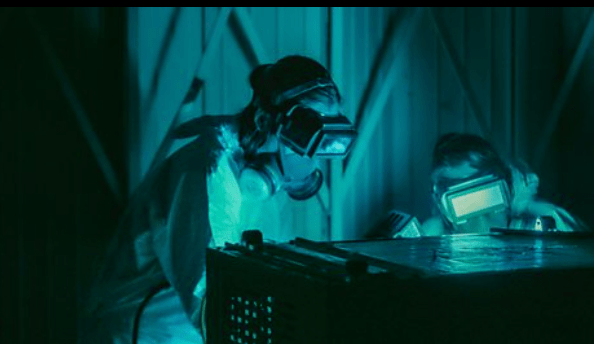
The forensic team recovered the skull from the corpse and via reconstruction software were able to match the skull to a photo of the flat’s registered tenant. This led to finding further background information about the victim and his live-in carer.
The carer via a prepared statement admitted placing the victim’s body in the freezer, which was not plugged in, 2-3 days after the death and keeping the corpse in the freezer for nearly 2 years!
The forensics team was tasked with finding out if the victim’s death was suspicious. Fingerprint analysis inside the fridge did not point to any signs of struggle and could not support the hypothesis that the body could have been placed in the freezer prior to the time of death.
Evidence abounded of trauma to the victim’s face. Large air spaces were found in the lungs, which could have been evidence of emphysema – the gradual damage of lung tissue, specifically the destruction of the alveoli (tiny air sacs). Atheromas (fatty accumulations in the arteries) were also found.
However, the advanced state of decomposition made it difficult to determine conclusively what may have caused the victim’s death; natural causes may indeed have been the root cause but forensics in this case were not able to ascertain the level of foul play.
This case was bizarre for a number of reasons. It seems that the victim suffered from dementia and the carer may have genuinely cared for the victim, but then kept the latter’s death a secret in order to gain financially.
Forensic scientists could not find enough medical evidence to answer all questions but were critical in helping to identify the victim despite the state of decomposition.
Time of Death
The second case also occurred in the West Midlands are of the UK and involved the brutal death of a 32 year old woman in the flat she shared with her partner. She was found on her bed with a large pool of blood, which had filtered through the mattress.
A manhunt ensued for her partner, which resulted in his arrest at his mother’s flat. I do not want to provide too many spoilers but the police investigation revolved around the frought relationship between the woman and her partner.
The forensic investigation again contributed greatly to the investigation. The cause of death was confirmed to be a result of blunt force trauma to the head. Other, older, injuries on the woman’s body indicated a possible escalation of violence over time.
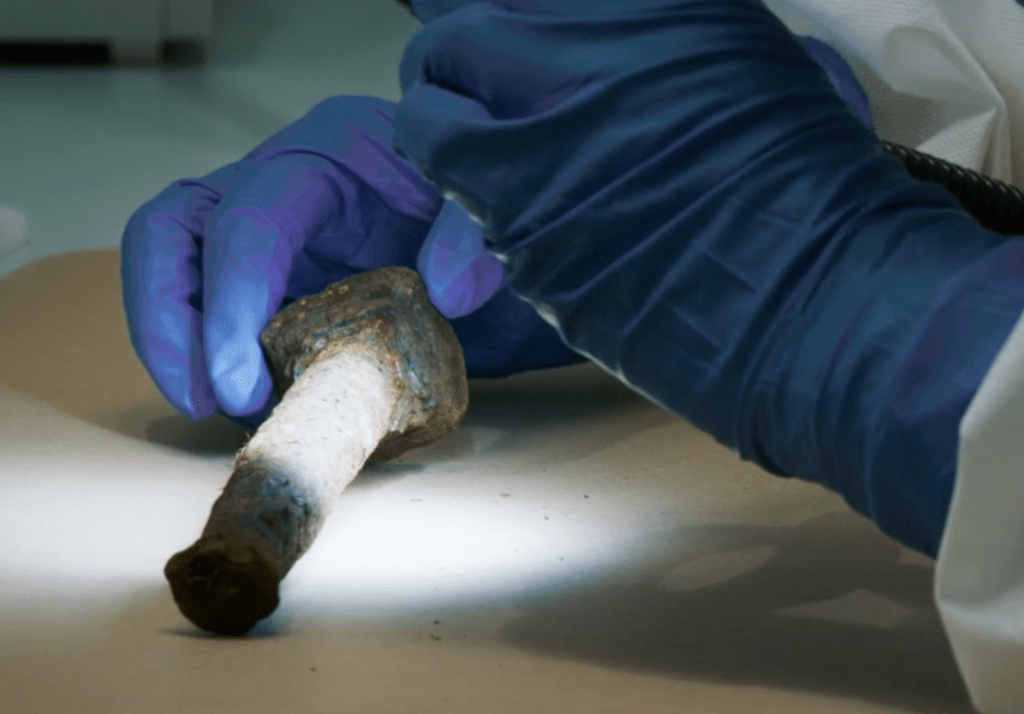
A possible murder weapon was tested to detect the presence of haemoglobin – the protein used by red blood cells to carry oxygen – but the test proved negative.
Saliva found on drinking vessels left at the flat were also tested for DNA but the results showed that both victim and her partner were the only people to have frequented the crime scenes.
Where forensics eventually provided a breakthrough was in linking the partner’s clothing with traces of blood belonging to the victim.
In both episodes summarised above, forensics played a major part in solving the mystery surrounding suspicious deaths. However, the quality and success of forensic investigation cannot be taken for granted so forensics alone cannot solve cases. Police detection work and the rigorous accumulation of other, non physiological, evidence is also just as important.
Overall, I believe this series, although maybe more suited for criminologists, will prove to be interesting to anyone with an interest in medicine and sheds light on the way investigations are carried out when serious crimes are committed.


 Meddie
Leave a comment