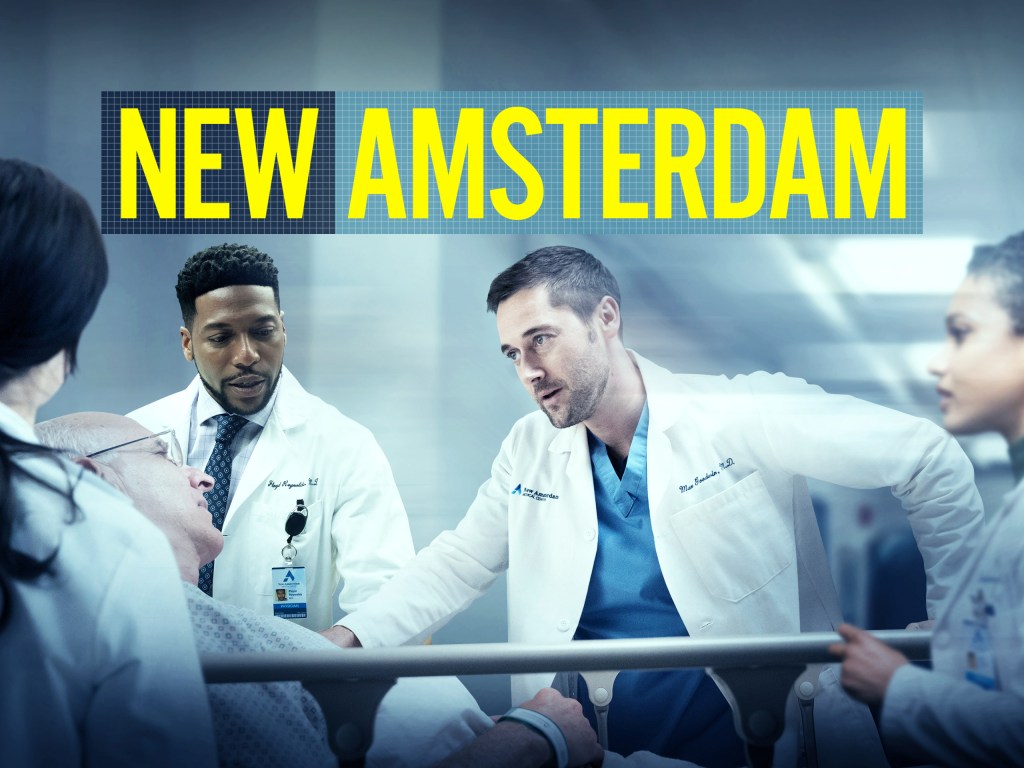
Personal review of Season 1 of the NBC medical drama series, currently broadcast in the UK via Amazon Video.
I have just completed watching the 22 episodes that comprise Season 1 of New Amsterdam, a series that chronicles the work and personal vicissitudes of the medical staff at the eponymous public hospital in New York City.
My first observation is that I was not aware the US healthcare system provided ‘public’ hospitals – the impression I had was that all healthcare was private and required payments in cash and/or subscription to a solid healthcare insurance policy.
It turns out that a minority of US hospitals are not-for-profit and are funded by US Government agencies and private donors. This does not mean that treatment is necessarily free to all patients (and the question of healthcare cost is a recurring theme in the series); however, treatment at public hospitals is generally cheaper and cannot be withheld from patients on the sole basis that they are not able to afford it.
Hence hospitals like New Amsterdam are closer to the UK vision of a free NHS than most US hospitals and yet everyday interactions with patients still need to be qualified in terms of bills recovery and cost benefits of different treatment options.
The first episode begins with Dr. Max Goodwin, the new medical director at New Amsterdam, addressing his staff and firing one of the departments for unethical billing behaviour. The director means business and makes it clear that he is not afraid of creating shockwaves so as to improve the service to patients.
All major recurring characters are introduced in the first two-three episodes:
- Dr. Lauren Bloom – head of the emergency/casualty department
- Dr Vijay Kapoor – head of neurology
- Dr. Iggy Frome – head of psychiatry
- Dr. Helen Sharpe (British actress Freema Agyeman) – head of oncology
- Dr. Floyd Reynolds – head of cardiothoracic sugery
Over the first season, the doctors learn how to work within the ‘revolutionary’ approach of Dr. Goodwin, finding a pragmatic approach and a new freedom to make improvements to their work practices and the way in which patients are treated.
As with all medical dramas, each episode interlaces complex cases of New York patients admitted to the hospital, with personal issues that each doctor faces both in their private and professional lives. The doctors are brilliant medical professionals but, as is the case for all humans, have flaws and baggage that define their outlook on life and their profession.
Fans of other US medical series will notice that the medical investigations in New Amsterdam are nowhere as obscure and complex as in, say, Fox network’s “House”. The aim of the series is not to present mysterious ailments that require one hour of twists and turns before the riddle is solved.
Instead, the recurring theme seems to be the struggle of a US healthcare system to provide for a population, especially when the patient is not wealthy or suitably covered by insurance. There are therefore, in my opinion, strong socialist themes in New Amsterdam, for example:
- inequality of medical outcomes based on patients’ race and socio-economic circumstances
- high cost of drugs resulting in huge sacrifices by patients and their family
- constant need of hospitals to justify costs and investments
The message of New Amsterdam is that by removing the monetary layer, hospitals could and should provide a much more comprehensive and fair service to the population.
The interactions between doctors are portrayed well and the actors produce some very strong performances. All doctors are fairly likeable and their storylines reinforce the notion of doctors being selfless and dedicated to their cause.
If anything, New Amsterdam is slightly predictable in that good generally overcomes evil. The character of the medical director Dr. Goodwin was – I found – impossibly nice …too nice… and that became irritating eventually.
There are many scenes demonstrating surgical procedures throughtout the series and aspiring medics will definitely learn about a number of ailments and treatments, as well as a primer on the US healthcare system.
The overall message is one of hope and dedication to the improvement of lives, and these are notions that all viewers will identify with. I really do recommend watching this series.


 Meddie
Leave a comment