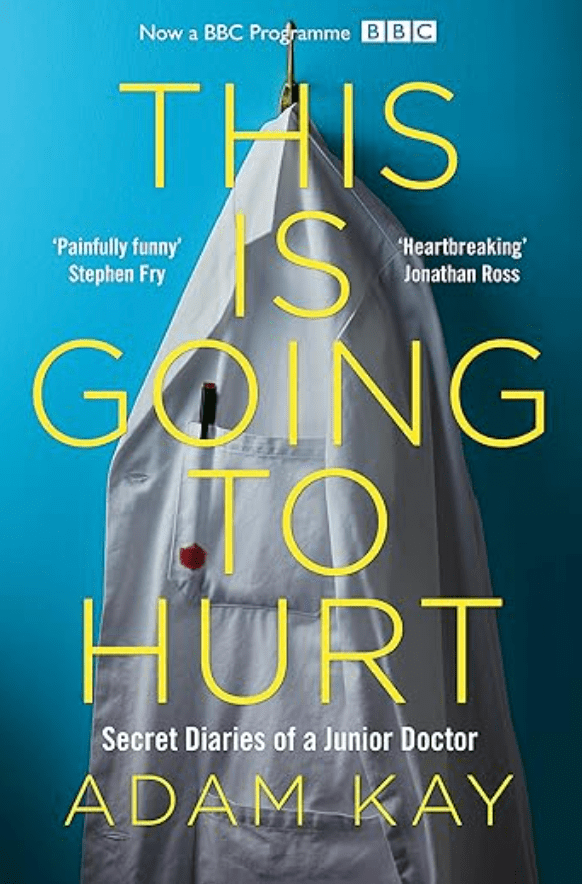
My personal review of Adam Kay’s book about his experience of working for the NHS.
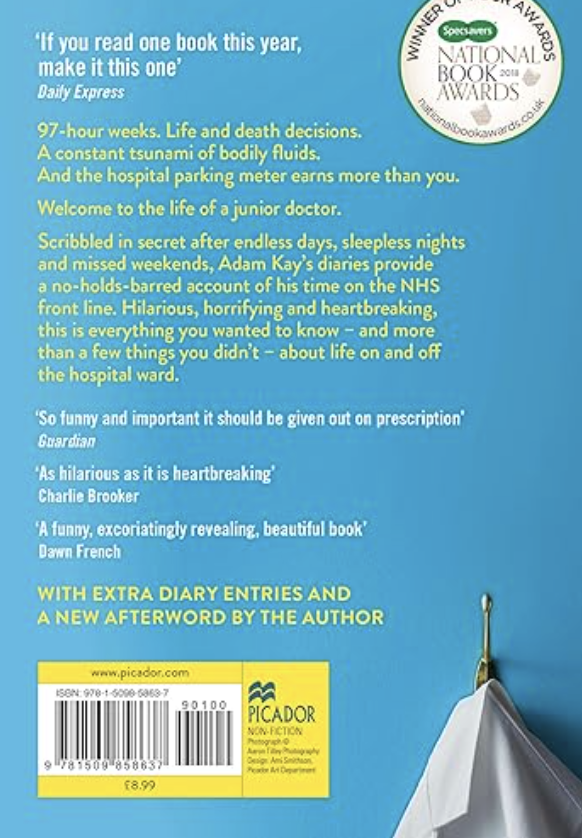
Book details:
| Publisher | Picador (2018) |
| Language | English |
| Pages (paperback) | 304 |
| ISBN-10 | 1509858636 |
| ISBN-13 | 978-1509858637 |
Review:
“This Is Going To Hurt” is a nonfiction book revealing the secret diaries of a junior doctor, Adam Kay, who published a plethora of his secret diary entries written during his time as a junior doctor specialising in gynaecology from 2004 until 2010, when he resigned.
Adam Kay begins with his first shift as a junior doctor: somewhat enjoying this new chapter in his life with a new stethoscope and email. He goes on to outline the vast array of cases he faces over the next few years, from urinary tract infections to life or death situations during childbirth, Kay acknowledges the physically and mentally exhausting side to his 97-hour weeks.
What makes this book unique, is Kay’s humorous take on the obstacles he faces. One moment that stood out to me was when Patient HT was normal, as proven from the “myriad of treatments” most doctors had tried. Dr Kay, naturally, feeling fed up with her delusion that she had a gynae problem, booked her in for yet another Doctor’s opinion in which he felt he was “throwing a colleague under the same bus I’ve just dodged a fare on”. This constant humorous approach, evident as to the fact he’s now a comedian, makes an attempt to conceal the dark side of medicine – patient complaints, things going wrong and situations of critical thinking to name a few.
Dr Kay also brought up the slight stigma of male doctors working in gynaecology. Due to religious and other reasons, he was asked if a female doctor was available to carry out a caesarean, in which he replied, “I’m telling you there are no female doctors in the hospital capable of performing a caesarean”. This stood out to me, as before reading this book I had anticipated that there would have been more than one junior doctor on each ward to aid in dire situations, and this also brought to light the shortage of doctors in the NHS.
Although most of his diary entries exhibited a sombre tone, Dr Kay also brought out the rewarding side of medicine. He highlighted how even the little things in life, such as “thank you” cards for delivering a couples’ baby, meant a lot to him and had the potential to boost his mental wellbeing. This, as a reader, made me feel very relieved for him, as it wasn’t often that he encountered happiness during his time as a junior doctor.
Unfortunately, his final diary entry working as a doctor before he quits finished heartbreakingly. The patient had undiagnosed placenta praevia (where the
placenta blocks the neck of the uterus) and resulted in the death of the baby. This also imposed detrimental effects on the mother, whom bled several litres and despite the brace sutures and blood transfusions, was told to expect the worst. This took a great toll on Dr Kay’s mental health, as he felt as if he had failed being the most senior person on his ward, causing it to be his final straw as a Senior Registrar.
This honest and open account from Dr Kay was a devastating way of ending the book, however as a reader I felt gratitude towards him for not repressing his emotions and for being honest as he showed how medicine will force you to encounter both rewarding days and horrible days. Unfortunately, these sad days were “remembered vividly” by Dr Kay, causing him to feel long-term guilt and sorrow.
I would highly recommend this book, as it has shown me the raw truth of what I would face as a (hopefully) future doctor.


 Meddie
Leave a comment